
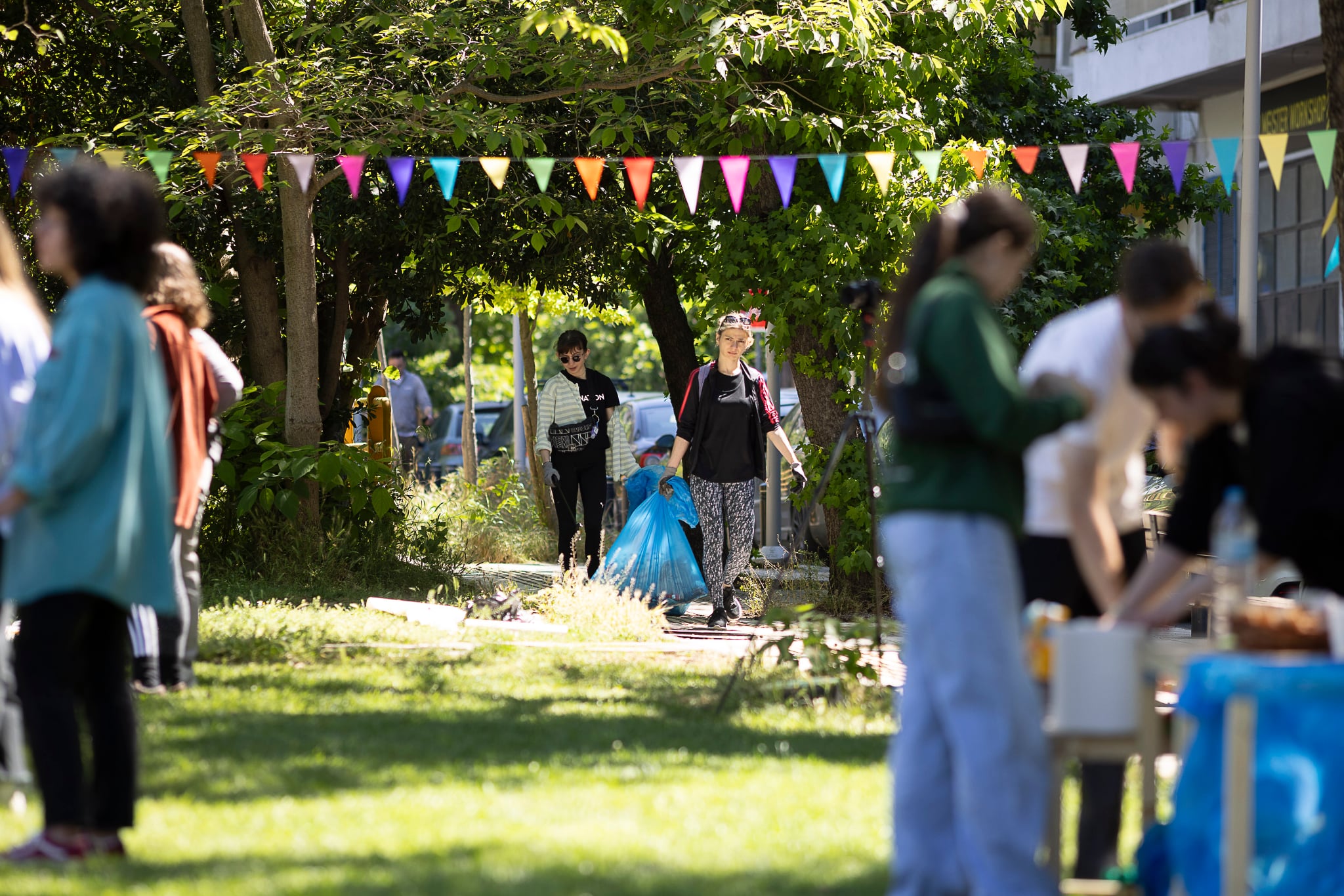
On Sunday, 18 May 2025, the participatory action“Nature within the city: A participatory day at Doxa’s urban stream” took place along Doxa’s urban stream in Thessaloniki. The action translated policy dialogue and expert discussion into a hands-on, place-based climate intervention, bringing residents, experts, children, and volunteers together directly within the stream landscape.
The activity built on insights from earlier public consultations at Thessaloniki City Hall and aimed to activate the stream as a living interface between nature, the city, and community life. Doxa Stream was used as a case study to explore how urban streams can function as green and blue infrastructures that support climate mitigation, flood resilience, biodiversity, and social cohesion when approached through placemaking.
From infrastructure to living place
Urban streams in Thessaloniki are often perceived as technical or invisible infrastructures. This action sought to shift that perception by inviting people to experience the stream as a shared public space, where environmental processes and everyday life intersect. The design of the day combined care, learning, play, and dialogue, reflecting a placemaking approach that embeds climate mitigation within collective experience.
The programme opened with a stream clean-up, coordinated with the volunteer group Cleaningans. Participants of all ages removed bulky waste and debris from the streambed and banks, directly contributing to the reduction of flood risk, especially at critical bottlenecks. Beyond its practical value, the clean-up served as a symbolic act of reclaiming the stream as part of the neighbourhood’s commons.
Climate mitigation through ecological understanding
A biodiversity walk, guided by Scientist Dr. Kakouros, deepened participants’ understanding of how ecological conditions relate to climate resilience. Attention was drawn to vegetation cover, soil health, and root systems as key factors in water absorption, erosion prevention, and microclimate regulation. Indicators such as earthworms signalled healthy soil, while invasive or human-introduced species pointed to ecosystem imbalance.
Flood risk was discussed in direct relation to climate change. The absence of surface water flow and the reliance on underground infrastructure increase vulnerability during intense rainfall events. Protecting stream banks through vegetation and limiting soil destabilisation were presented as low-tech, nature-based mitigation measures that can significantly enhance urban resilience.
Community dialogue and placemaking insights
The action concluded with an open discussion on site, bringing together residents, experts, and local initiatives. Participants reflected on the stream’s role in neighbourhood life and the barriers preventing its fuller integration into everyday use. A recurring theme was the lack of participatory governance mechanisms that would allow residents to contribute meaningfully to the care, design, and activation of streams.
With input from Thodoris Istoriou (PhD Candidate, AUTH), the discussion highlighted the work of the Doxa Residents’ Initiative, demonstrating how small, consistent actions can build a sense of belonging and collective responsibility. Participants emphasised that placemaking does not require large-scale interventions. Simple activities like walks, clean-ups, informal gatherings, and children’s events can gradually transform perception and use.
Ideas emerging from the discussion included improved lighting for safety, seating and stopping points, educational and cultural activities, and regular community-led stewardship actions. These proposals framed the stream as a potential climate commons: a space for cooling, learning, social interaction, and environmental care.
Children as climate placemakers
Running in parallel, a creative workshop for children, invited younger participants to imagine the future of Doxa Stream through collage-making. Children depicted the stream as a place for play, exploration, freedom, and contact with nature, highlighting how early engagement fosters long-term environmental awareness and attachment.
By placing children at the centre of the placemaking process, the workshop reinforced the idea that climate mitigation is also cultural and generational, rooted in how future citizens relate to their environment.
Key outcomes
Approximately 84 people participated throughout the day, including residents, families, experts, volunteers, and passers-by who joined spontaneously. The open, accessible format transformed the stream into a temporary public forum, demonstrating how placemaking can lower barriers to participation and activate climate action beyond formal settings.
The Doxa Stream action showed that climate mitigation becomes tangible when experienced in place. By combining care, knowledge, and community interaction, the stream was reimagined not as a forgotten infrastructure, but as a living socio-ecological system, capable of cooling the city, reducing risk, supporting biodiversity, and strengthening neighbourhood ties.
This experience confirms that placemaking is a powerful pathway for climate mitigation, enabling cities to connect policy goals with everyday practices, and empowering communities to co-create resilient urban futures, starting from the spaces just outside their doorstep.
Placemaking for Climate Mitigation is funded by the European Union. Views and opinions expressed are however those of the author(s) only and do not necessarily reflect those of the European Union or the European Education and Culture Executive Agency (EACEA). Neither the European Union nor EACEA can be held responsible for them.